

Need Help After the Death of a Family Member?
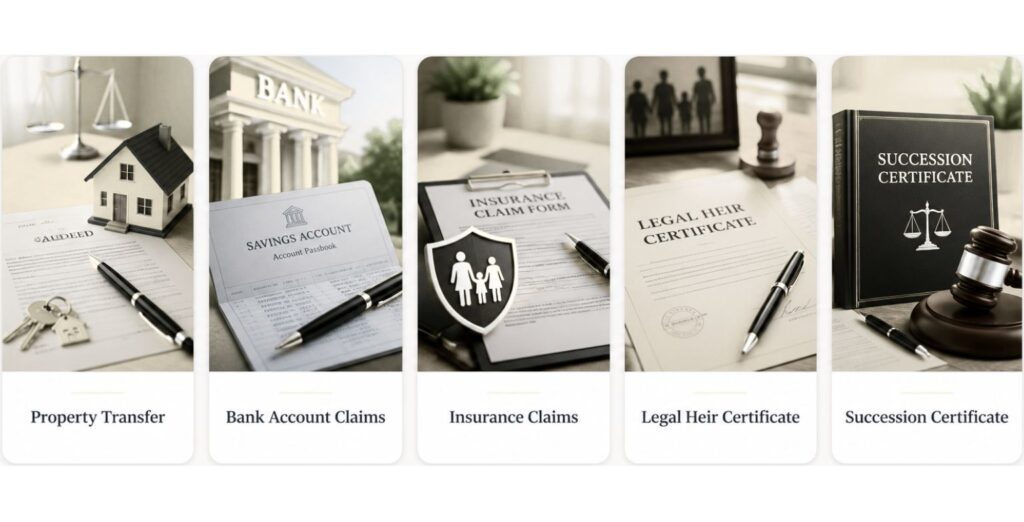

Not sure which legal document you need?
The passing of a loved one often brings emotional as well as practical responsibilities. Families may suddenly need to update property records, access bank accounts, claim insurance, transfer investments, or complete other legal formalities. During this process, many people are informed that they require a Legal Heir Certificate, but are unsure what it is, where to obtain it, or whether it is the correct document for their situation.
Advocate Chinmay Chorghe can help you understand the appropriate legal process based on your situation.
If you are searching for a Lawyer for Legal Heir Certificate in Navi Mumbai, this guide explains the purpose of a Legal Heir Certificate, situations where it may be required, the general procedure followed in Maharashtra, documents commonly requested, and the difference between a Legal Heir Certificate and other legal processes such as a Succession Certificate or Probate.
Common Legal Matters After the Death of a Family Member
If you have recently lost a parent, spouse, or close relative, you may be dealing with more than grief. You may also be trying to figure out practical matters such as:
✔ Property transfer – updating the 7/12 extract, property card, or society share certificate after the death of a family member
✔ Bank account claims – accessing a deceased person’s savings account or locker
✔ Fixed deposits – claiming FDs held in the deceased’s name
✔ Insurance claims – submitting a claim to an insurance company where the nominee details are unclear or absent
✔ Transfer of shares and investments – updating demat accounts, mutual funds, or company shares
✔ Updating government records – ration card, electricity connection, property tax records
✔ Identifying legal heirs – establishing, on record, who the rightful heirs of the deceased are
Many people arrive at this stage assuming they simply need a “Legal Heir Certificate.” In some cases, that is correct. In other cases, particularly where there is a dispute, a large estate, immovable property outside Maharashtra, or a will involved, a different legal process such as a Succession Certificate, Probate, or Letters of Administration may be more appropriate.
The right process depends entirely on the facts of your case: what assets are involved, whether there is a will, whether all heirs are in agreement, and which authority or institution is asking for the document.
This page focuses on the Legal Heir Certificate – what it is, when it’s used, and how to apply for one in Maharashtra. If your situation is more complex, Advocate Chinmay Chorghe can help you identify the correct process during a consultation.
What is a Legal Heir Certificate?
A Legal Heir Certificate is an official document issued by a competent revenue authority (typically the Tehsildar or a Sub-Divisional Magistrate) in Maharashtra. It identifies the legal heirs of a person who has died, based on the applicable succession law.
In simple terms, it is a government record that says: “These are the people recognised as the legal heirs of the deceased.”
It is commonly used for relatively straightforward administrative purposes, such as:
- Transferring utility connections (electricity, gas) into an heir’s name
- Claiming employment benefits, pension, or gratuity of a deceased government employee
- Processing smaller bank account claims
- Certain property mutation procedures at the local revenue office
A Legal Heir Certificate is different from a Succession Certificate, which is issued by a civil court and carries wider legal authority, particularly for claiming debts, securities, and other movable assets, including in cases of dispute. We explain this difference in detail further down this page.
When is a Legal Heir Certificate Required?
Here are real-life situations where people typically need this certificate:
"My father passed away, and the bank is asking for documents to release his account." Banks often ask for a Legal Heir Certificate (in addition to other documents) before releasing funds from a deceased account holder's account, especially where there was no nominee.
"My mother passed away, and we want to transfer the flat to our names." Housing societies and municipal authorities may request a Legal Heir Certificate as part of the property mutation or share transfer process.
"We need to claim my husband's life insurance policy." If the nomination on the policy is unclear, outdated, or absent, the insurer may request proof of legal heirship before processing the claim.
"My father had shares and mutual funds- how do we transfer them?" Depository participants and registrars may require a Legal Heir Certificate, along with other documents, to transfer securities to the legal heirs.
"We don't know who is legally entitled to what." Even before any specific claim is made, families sometimes need clarity on record about who the legal heirs are, particularly if there are multiple children, remarriages, or other family complexities.
"The government office is asking us to update records after my parent's death." Ration cards, property tax records, and other government records often need to be updated to reflect the legal heirs.
If your situation matches one of these or something similar a Legal Heir Certificate may be the right document to start with.
Who Can Apply for a Legal Heir Certificate?
Generally, the following persons are recognised as legal heirs and may apply:
- Spouse of the deceased
- Children of the deceased (sons and daughters)
- Parents of the deceased (in certain circumstances, particularly if the deceased had no spouse or children)
The exact list of legal heirs depends on the personal law applicable to the deceased (for example, the Hindu Succession Act, 1956 for Hindus, Buddhists, Sikhs, and Jains, or other applicable personal laws for other communities).
Typically, any one of the legal heirs can apply for the certificate on behalf of the family, but all legal heirs are usually required to be named and, in many cases, to provide consent or a no-objection as part of the application.
Because the applicable law and required consents can vary based on your family’s circumstances, it is advisable to confirm this before applying.
Documents Generally Required for legal Heir Certificate
While requirements can vary slightly between different revenue offices (Tehsildar/Talathi offices) in Maharashtra, applicants are generally asked to provide:
✔ Death certificate of the deceased (issued by the Municipal Corporation or Gram Panchayat)
✔ Proof of identity of the applicant (Aadhaar Card, PAN Card, Voter ID)
✔ Proof of residence of the deceased and the applicant
✔ Ration card, if available, showing family members
✔ Details of all legal heirs (names, addresses, relationship to the deceased)
✔ Self-declaration or affidavit stating the relationship of the applicant and other heirs to the deceased
✔ Passport-size photographs of the applicant
✔ Address proof of legal heirs (if residing at different addresses)
Some offices may also request additional documents depending on the specific case for example, a birth certificate, marriage certificate, or a family tree document.
Tip: Keeping all documents organised and consistent (same spelling of names across documents, for instance) significantly reduces delays.
Step-by-Step Procedure to Apply for a Legal Heir Certificate in Maharashtra
- Gather the required documents Collect the death certificate, identity proofs, address proofs, and details of all legal heirs as listed above.
- Prepare the application The application is typically made to the Tehsildar or Sub-Divisional Magistrate having jurisdiction over the deceased’s last place of residence. This can often be initiated online through the Maharashtra government’s Aaple Sarkar portal, followed by submission of physical documents where required.
- Submit the application along with supporting documents This includes the death certificate, identity and address proofs, and a declaration regarding the legal heirs.
- Verification by the Talathi / Revenue Officer The local Talathi (village-level revenue officer) typically conducts a field-level verification, which may include visiting the residence or speaking to neighbours/local residents to confirm the family details provided.
- Public notice period (in some cases) Certain offices may issue a notice inviting objections, if any, from the public before finalising the list of legal heirs.
- Issuance of the certificate Once verification is complete and there are no objections, the Legal Heir Certificate is issued, listing all recognised legal heirs of the deceased.
- Use the certificate for your specific purpose Submit the certificate to the relevant bank, insurance company, government office, or society, along with any other documents they require.
Typical timeline: This process commonly takes anywhere from a few weeks to a couple of months, depending on the workload of the local office, the completeness of documents, and whether any objections are raised. Delays are common when documents are incomplete or inconsistent.
Legal Heir Certificate Fees
People often search for a fixed price when looking for this service, but it is important to understand that legal costs are not one-size-fits-all.
The overall cost involved in obtaining a Legal Heir Certificate or a related process like a Succession Certificate, can vary based on factors such as:
- Government fees and stamp duty applicable at the relevant office
- Whether the matter is straightforward or involves complications (disputes, missing documents, multiple heirs residing in different cities, etc.)
- Whether professional legal assistance is required for drafting, follow-up, or representation
- Whether the matter needs to go beyond the revenue office for example, to a civil court for a Succession Certificate
- Rather than quoting a fixed number that may not apply to your situation, it is best to discuss your specific circumstances directly. Advocate Chinmay Chorghe can explain the likely costs involved once he understands the details of your case.
Should You Consult an Advocate or a Documentation Agent?
Many people search for terms like “legal heir certificate agents near me” while trying to get this certificate quickly and without hassle. Documentation agents can be helpful for straightforward, undisputed cases where the main task is form-filling and document submission.
However, there are situations where consulting an advocate is particularly useful:
- When there is a family dispute about who the legal heirs are, or disagreement between family members
- When a bank, company, or institution rejects the Legal Heir Certificate and insists on a Succession Certificate instead
- When the deceased left a will, and it isn’t clear whether probate or letters of administration is required
- When the estate includes property in multiple states, or complex assets like business shares
- When there are minor children among the legal heirs, requiring special legal safeguards
- When you are unsure which legal process applies to your specific situation
An advocate can also represent you if the matter needs to escalate to a civil court, which a documentation agent is not authorised to do.
If your situation is simple and uncontested, a straightforward application may be all that’s needed. If there is any complexity, disagreement, or uncertainty, getting legal guidance early can save significant time and prevent complications later.
Client Testimonials

Why Consult Advocate Chinmay Chorghe
Advocate Chinmay Chorghe assists clients across Koparkhairane, Vashi, Ghansoli, Sanpada, Nerul, and Airoli with Legal Heir Certificate applications and related succession matters, including guidance on Succession Certificates, Probate, and Letters of Administration where applicable.
During a consultation, he will:
- Review the facts of your specific situation
- Explain which legal process is actually applicable to you
- Guide you through the documents required
- Assist with the application and follow-up process
- Represent you in court, if your matter requires escalation to a Succession Certificate or Probate proceeding
This page is intended to give you a clear starting point not to replace personalised legal advice. Every family’s situation is different, and the right next step depends on your specific facts.
Speak to a Heirship Certificate Lawyer in Navi Mumbai Today
Frequently Asked Questions (FAQs)
1. What is a Legal Heir Certificate used for?
It is generally used to establish, before government offices, banks, and other institutions, who the legal heirs of a deceased person are commonly for purposes like utility transfers, pension claims, and smaller bank account claims.
2. Who issues the Legal Heir Certificate in Maharashtra?
It is typically issued by the Tehsildar or Sub-Divisional Magistrate having jurisdiction over the area where the deceased last resided.
3. How is a Legal Heir Certificate different from a Succession Certificate?
A Legal Heir Certificate is issued by a revenue authority for administrative purposes, while a Succession Certificate is issued by a civil court and carries broader legal authority, particularly for claiming debts and securities.
4. Can I apply for a Legal Heir Certificate online in Maharashtra?
Many applications can be initiated online through the Maharashtra government's Aaple Sarkar portal, though physical document submission and verification are usually still required.
5. How long does it take to get a Legal Heir Certificate?
This varies by office and case, but it commonly takes a few weeks to a couple of months, depending on document completeness and whether verification proceeds without objections
6. What documents are needed for a Legal Heir Certificate?
Commonly required documents include the death certificate, identity and address proof of the applicant, ration card, and details of all legal heirs. See the checklist section above for more detail.
7. Who are considered legal heirs under Hindu law?
Under the Hindu Succession Act, 1956, Class I heirs generally include the spouse, children, and mother of the deceased. If there are no Class I heirs, the law moves to Class II heirs and beyond.
8. Can a daughter apply for or be included in a Legal Heir Certificate?
Yes. Daughters are recognised as legal heirs under applicable succession laws, along with sons and the spouse of the deceased.
9. Is a Legal Heir Certificate valid across all of India?
It is generally accepted within the issuing state for the purposes it's meant to serve, but some institutions outside the state, or for larger transactions, may still ask for a Succession Certificate.
10. What if a bank refuses to accept a Legal Heir Certificate?
Some banks, especially for larger claims, may insist on a Succession Certificate instead. This is something to clarify with the bank directly, and an advocate can help you determine the right next step.
11. Can a Legal Heir Certificate be used to sell inherited property?
It can support the process of updating ownership records, but for sale of immovable property, additional documentation and legal steps are usually involved, especially if there are multiple heirs.
12. What happens if there is a dispute among legal heirs?
If heirs disagree about entitlement or shares, the matter may need to move beyond a simple Legal Heir Certificate application, potentially requiring court intervention.
13. Do all legal heirs need to be present to apply?
Not necessarily, but details and, in many cases, consent or no-objection from all legal heirs are typically required as part of the process.
14. What is the role of the Talathi in this process?
The Talathi (village-level revenue officer) usually conducts field verification to confirm the family and heir details submitted in the application.
15. Can a Legal Heir Certificate be obtained without a death certificate?
No. A death certificate is a mandatory supporting document, as it establishes the fact of death, which is the foundation of the entire application.
16. What if the deceased left a will?
If there is a valid will, the relevant process is usually Probate or, in some cases, Letters of Administration, rather than a simple Legal Heir Certificate. This depends on the specific facts and should be discussed with an advocate.
17. Is court appearance required to get a Legal Heir Certificate?
Generally, no — this is an administrative process handled by the revenue department, unlike a Succession Certificate, which requires a court petition.
18. How much does it cost to get a Legal Heir Certificate?
Costs vary depending on government fees, the complexity of the case, and whether professional assistance is needed. See the "Legal Heir Certificate Fees" section above for more detail.
19. Can NRIs apply for a Legal Heir Certificate for a deceased family member in India?
Yes, though the process may involve additional documentation, such as a Power of Attorney, if the NRI heir cannot be physically present. This is best discussed individually.
20. What should I do first after a family member's death, before applying for any certificate?
Start by obtaining the official death certificate from the Municipal Corporation or Gram Panchayat, as this is required for almost every subsequent legal or administrative step, including a Legal Heir Certificate application.
21. Can a Legal Heir Certificate be corrected if there is an error after issuance?
Errors can sometimes be corrected through a follow-up application or representation to the issuing authority, though the process depends on the nature of the error.
22. What is the difference between a legal heir and a nominee?
A nominee is a person designated to receive an asset on behalf of the legal heirs, primarily as a custodian, whereas legal heirs are those legally entitled to inherit under succession law. These can sometimes be different people, which is a common source of confusion and disputes.
Open A Case
This page provides general legal information for educational purposes and does not constitute legal advice or create an advocate-client relationship. Please consult Advocate Chinmay Chorghe directly for advice specific to your circumstances. This content complies with the Bar Council of India’s rules on advertising and solicitation and does not claim or guarantee any outcome.